





Offset vs Digital Press
12/03/2025
Understanding digital and offset printing processes, technology and applications in printing.
Digital and offset printing serve as complementary tools in the printing landscape, catering to different requirements and preferences. Offset printing, with its traditional roots, excels in producing large quantities with precise color accuracy, making it ideal for high-volume publications and branding materials. On the other hand, digital printing offers flexibility and speed, ideal for smaller quantities and personalized projects.
From the intricate details of plate creation in offset printing to the direct image transfer of digital printing, each method has its way of operating. This article delves into the inner workings of both digital and offset printing, providing a comprehensive overview of how they operate and the roles they play in contemporary printing.
The Evolution of Printing Technology
Like many industries reliant on machinery, printing is deeply intertwined with technology. From the ancient Chinese woodblocks to Gutenberg's revolutionary printing press, technological advancements have continually expanded the possibilities of printing. Today, modern printing relies primarily on two key technologies: offset printing and digital printing.
Professional printing services cater to clients with diverse printing needs, utilizing both digital and offset presses to deliver exceptional results. These services have expanded as more clients seek solutions that surpass the limitations of home printers. Professional printers excel in areas such as:
Quality: Achieving higher resolution and sharper images.
Size: Producing large-format prints, such as posters and banners.
Longevity: Utilizing inks and materials that resist fading and wear.
Color Accuracy: Precisely matching colors using advanced color management systems.
Material Variety: Printing on a wide range of materials, including cardstock, vinyl, and textiles.
Understanding the Basics
Offset Printing
Offset printing is a technique that uses large machines to transfer an image onto paper via a series of plates and rollers. Here’s a breakdown of the process:
Creating Print Plates: The process begins with creating print plates, which are customized for each job. These plates hold the image or text that will be printed.
Transfer to Intermediate Medium: The image is transferred from the print plates to a rubber blanket, which is the intermediate medium.
Final Transfer to Printing Surface: Finally, the image is transferred from the rubber blanket to the printing surface, ensuring a high-quality print.
Offset printing is renowned for its ability to produce sharp and clean images, making it ideal for large print runs where consistency and quality are paramount. However, this method is less flexible when it comes to small runs or customized designs due to the need for creating new plates for each change.
Digital Printing
Digital printing leverages technology similar to that found in computer printers but on a larger scale. Instead of a desktop machine, digital printers are standalone units designed for high-volume and wide-format printing. Digital printing offers several key features:
Digital File Creation: The process starts with a digital file, which can be easily altered or customized without the need for new plates.
Direct Printing: The image is printed directly onto the material. Unlike offset printing, where the image is transferred via an intermediate medium, digital printing applies the image directly to the surface.
Wiping Clean: One of the unique aspects of digital printing is that it wipes the image clean after every single impression. This feature allows for a lot more flexibility in printing, making it possible to produce small runs and a variety of designs quickly and efficiently.
Digital printing excels in producing vibrant, customizable prints on demand. This flexibility makes it ideal for personalized marketing materials, small batch projects, and designs that frequently change.
Key Operational Differences
Production Volume and Cost Efficiency
Small-Run Production
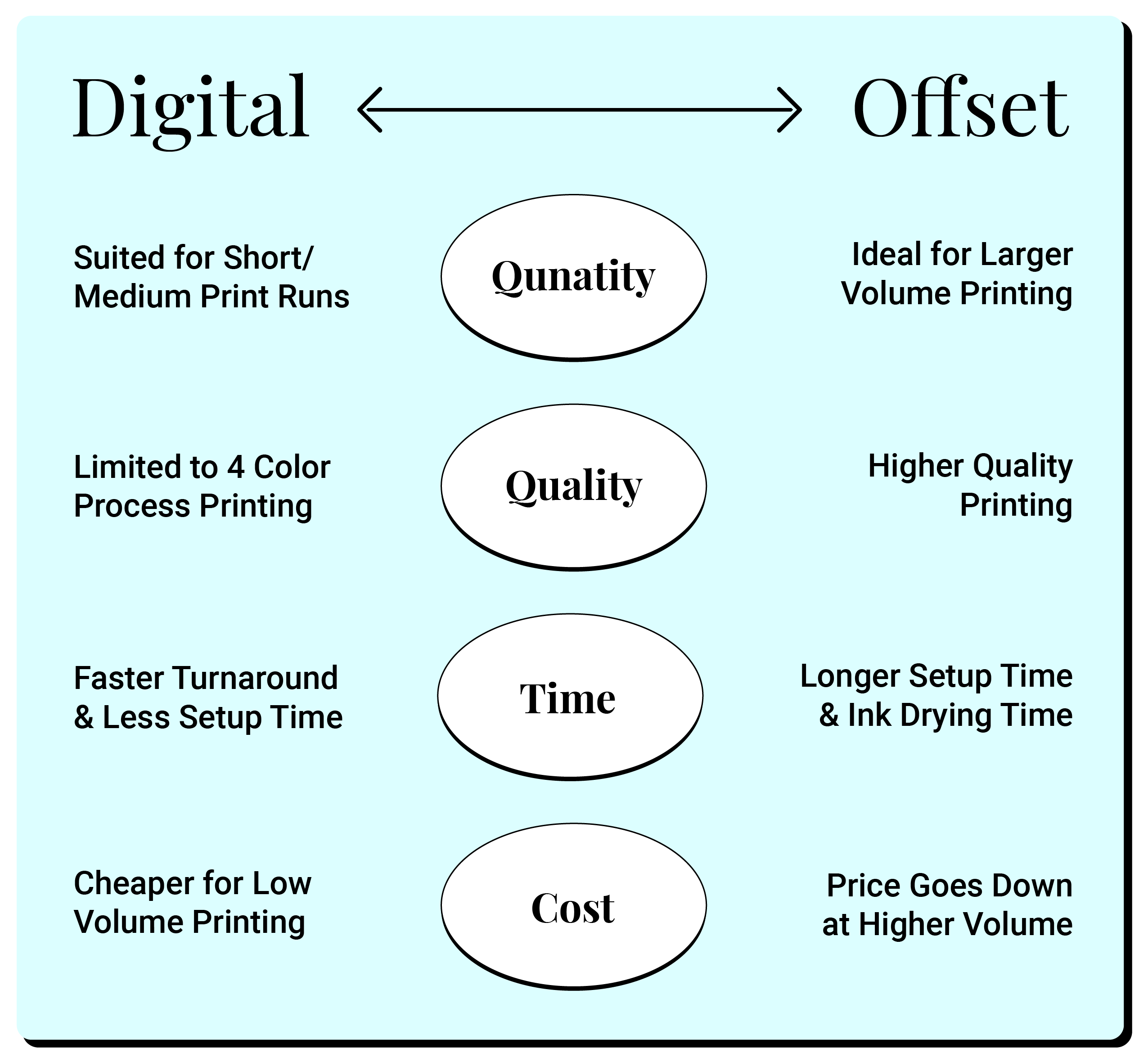
Digital printing shines for small quantities, offering consistent per-unit costs regardless of volume. With minimal setup requirements, digital printing enables cost-effective production of as few as one copy, making it ideal for:
Prototypes and proofs
Personalized marketing materials
Limited edition publications
On-demand printing needs
Large-Run Production
Offset printing requires significant setup but becomes increasingly cost-effective as quantities grow. The setup costs are distributed across more units, substantially lowering the per-piece price. Offset typically becomes economical at:
500-1,000 pieces for simple projects
1,000+ pieces for standard commercial printing
5,000+ pieces for maximum cost efficiency
Print Quality and Color Accuracy
Digital Print Quality
Modern digital presses produce excellent results with:
Resolution typically between 600-2400 dpi
Sharp text reproduction
Consistent color throughout the run
Vibrant photographic reproduction
However, digital printing may show slight banding in large color areas and lacks the absolute color precision of offset for brand-critical applications.
Offset Print Quality
Offset printing remains the gold standard for premium quality with:
Extremely fine detail reproduction
Smooth gradients and solid colors
Precise Pantone color matching
Superior rendering on uncoated papers
The human-operated nature of offset presses means there can be slight variations between print runs, though they remain remarkably consistent.
Turnaround Time
Digital Production Speed
Digital printing offers quick turnaround benefits:
No plate creation or complex setup
Immediate printing from approved files
Rapid completion of small to medium runs
Same-day or next-day delivery is possible for urgent projects
Offset Production Speed
Offset printing involves a longer preparation process:
Plate creation for each color
Press calibration and color matching
Test prints and adjustments
However, once running, offset presses operate at high speeds, making them efficient for large volumes despite longer setup times.
Sheet Size and Format
The physical dimensions of your project can also dictate which printing method is appropriate.
Digital Printing
Typically limited to smaller sheet sizes
Generally between 19-29 inches depending on the equipment
For larger formats, wide-format digital printing is available but has its limitations
Offset Printing
Can accommodate larger sheet sizes
Typically from 29-40 inches
Better suited for large-format projects that would be impossible or impractical with standard digital printing
Material Versatility
Digital Material Options
Digital printing technology has expanded to accommodate:
Standard papers from lightweight to moderately heavy stocks
Specialty papers including textured options
Synthetic materials like vinyl and polyester
Rigid substrates with flatbed digital printers
Material limitations exist primarily in very heavy stocks and some specialty finishes.
Offset Material Options
Offset printing excels with a wide range of materials:
Virtually all paper weights and finishes
Specialty stocks including metallic papers
Unique textures and finishes
Absorbent materials that digital inks might oversaturate
The mechanical pressure of offset printing also allows for special effects like embossing when combined with additional processes.
Variable Data Capabilities
Digital Personalization
One of digital printing's greatest strengths is variable data printing:
Each piece can contain unique text, images, or codes
Database-driven personalization for targeted marketing
Sequential numbering or coding
Version control for different audience
Offset
Traditional offset printing produces identical pieces throughout the run. Variable information requires:
Additional digital imprinting after offset printing
Pre-printed shells with variable data added later
Multiple plate changes for version changes, which is costly
Final Word
Digital and offset presses each play a crucial role in the printing industry, offering distinct capabilities. Digital presses allow for quick turnaround times and the ability to print personalized materials, making them ideal for projects that require flexibility and speed. They excel in producing small to medium quantities efficiently, enabling businesses to respond rapidly to market demands.
FAQs
What is the main difference between offset and digital printing?
Offset printing is better for large quantities and precise color matching using Pantone inks. Digital printing is more cost-effective for smaller quantities and allows for variable data printing.
What is the fastest possible turnaround for digital printing?
Many print providers offer same-day service for simple digital printing projects submitted with print-ready files early in the day. Standard turnaround is typically 1-2 business days for straightforward projects.
Is paper quality different between digital and offset printing?
Both technologies can use high-quality papers, but they interact differently with the substrate. Digital printing sits more on the surface of the paper, while offset inks are absorbed more deeply. This difference is most noticeable on uncoated stocks, where offset often produces richer results.
What types of materials can be printed on with digital printing?
Digital printing can handle various materials including paper, plastic, vinyl, and canvas.
Is it possible to combine digital and offset printing in one project?
Yes, hybrid approaches are increasingly common. For example, a catalog might have its cover and standard pages printed offset for quality and economy, while incorporating digitally printed personalized inserts or variable coupons.
We at Machine Dalal have a wide selection of print, packaging, and converting machines listed with us. Industry sellers from all over the world list their print equipment with us to reach interested buyers who regularly visit our platform to find equipment that matches their needs.
At Machine Dalal, we connect the supply and purchasing needs of the print industry.
Machine Dalal is the global trading platform for the printing, packaging, and converting industry—designed to evolve with the needs of the market. We are continually innovating - from powerful search tools to integrated social media marketing, a growing newsletter audience, and our newly launched digital magazine, we are building a robust ecosystem to support print machinery sellers and buyers worldwide.
For a more personalized experience, download our mobile apps on Android and iOS.
To explore business opportunities or partnerships, feel free to get in touch with us.


Can’t find the right machine?
Post your requirements and get offers from verified dealers and sellers across the platform.
Start Selling to the Global Print Industry
List your machinery on Machine Dalal and connect with verified buyers, dealers, printers, and converters from around the world. Manage your listings, receive enquiries, and grow your business through the industry's leading marketplace.
Business Unlimited Plan — $99/year